Congo burrowing asp
(Atractaspis congica)
Description
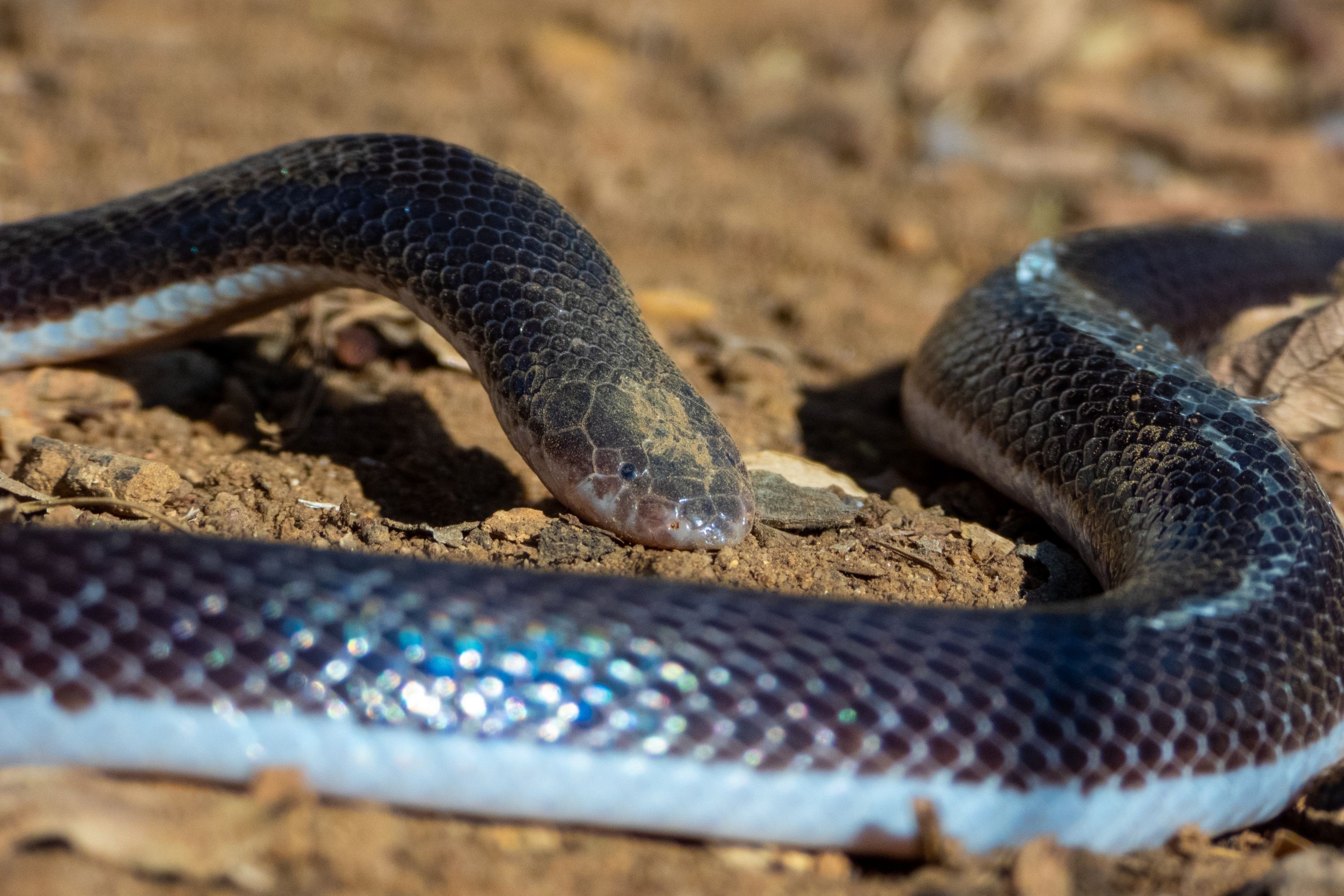
Atractaspis congica, commonly known as the Congo burrowing asp, is a species of venomous snake in the family Atractaspididae. It is found in Africa. Uniformly dark brown or black both dorsally and ventrally. Snout very short and rounded. Portion of rostral visible from above about half as long as its distance from the frontal. Smooth dorsal scales in 19 or 23 rows. Ventrals 200–230; anal divided; subcaudals 19–23, a few of the anterior entire, the remainder in two rows. Adults may attain a total length of 45 cm (17+3⁄4 in), with a tail 3.5 cm (1+3⁄8 in) long. Atractaspis is a genus of venomous snakes in the family Lamprophiidae. The genus is endemic to Africa and the Middle East. The genus contains 15 species that are recognized by ITIS. Others recognize as many as 21 species. 23 are listed here. Members of the genus Atractaspis share the following characteristics. Venom fangs enormously developed; a few teeth on the palatines, none on the pterygoids; mandibles edentulous anteriorly, with 2 or 3 very small teeth in the middle of the dentary bone. Postfrontal bone absent. Head small, not distinct from neck, covered with large symmetrical shields; nostril between 2 nasals; no loreal; eye minute, with round pupil. Body cylindrical; dorsal scales smooth, without apical pits, in 17 to 37 rows; ventrals rounded. Tail short; subcaudals either single or in two rows. Common names for snakes of the genus Atractaspis include burrowing vipers, burrowing asps, mole vipers, stiletto snakes, side-stabbing snakes. "Side stabbing" refers to the snakes' uncommon ability to strike with the side of their head and inject venom with one protruding fang. Species of the genus Atractaspis are found mostly in Sub-Saharan Africa, with a limited distribution in the Jordan valley in Israel, Palestine and the Arabian Peninsula.
Taxonomic tree: